

WELCOME TO
The Academic Blog

Thierry Mugler: An Architect of Extreme Glamour and Serious Strength
The Mugler-impact was undeniable, as we would certainly live to see well into the decades to come. Since the late 2000s, Mugler’s work has been introduced to generations of young people, especially through such cultural influencers as Lady Gaga, Beyoncé and Cardi B. His commitment to presenting the female as powerful and self-determined is one that has resonated with many, and has certainly helped to keep the name “Mugler” alive and on fire.
“In my work I’ve always tried to make people look stronger than they really are.”

Bigger than Big
Thierry Mugler is an eternal staple at the intersection of fashion, beauty and design. Emerging as a major player in the fashion scene of the 1980s and 1990s, he became quite popular for his larger than life concepts, and maintained a high level of respect among luminaries in style and pop culture for decades to come.
In an article published by The New York Times, Vanessa Friedman pulls a quote from Montreal Museum of Arts curator, Thierry-Maxime Loriot, who described Mugler as a “pioneer when it came to women’s empowerment and diversity, starting in the 1970s.” (The New York Times, 2022) She later goes on herself to describe his followup work as “kitsch razzle-dazzle,” suggesting that what he produced after the sale of his brand to Clarins in 1997 was a bit off compared to what people had come to know and love of him.
Still, the Mugler-impact was undeniable, as we would certainly live to see well into the decades to come. Since the late 2000s, Mugler’s work has been introduced to generations of young people, especially through such cultural influencers as Lady Gaga, Beyoncé and Cardi B.
“In my work I’ve always tried to make people look stronger than they really are.” – Thierry Mugler
His commitment to presenting the female as powerful and self-determined is one that has resonated with many, and has certainly helped to keep the name “Mugler” alive and on fire.

A Relentless Pioneer
There are many notable takeaways from the overview of his career, as referenced in the New York Times. For one, there’s the embrace of faux fur and printed leather well before the fashion world adhered to a campaign of minimising animal cruelty for the sake of style. Another example of Mugler’s pioneerism is the experimentation with exposing the rear end of the model – this is something Vanessa notes Mugler did before McQueen “introduced the bumster.” In another lens of channelling his inner pioneer, Thierry cast drag queens in his shows, right alongside the most respected and prominent female models who also walked in his runway shows.
The list of acts that made Mugler a pioneer in the worlds of fashion, art and style go on. He was one of the select designers featured in famed photographer of the 1980s, Lucille Khornak’s first book, Fashion 2001.

Challenger of the Impossible
One of the biggest things people admire about Thierry Mugler and his work was his commitment to the curious and the unexpected. One of his most iconic pieces, a dress called “La Chimère,” reportedly took “thousands of hours to create,” featuring “a rainbow of exactingly beaded scales that form the iridescent carapace of a mythic creature.” It presented such complications for the advent of getting it on the body that it is said to have always travelled on a mannequin. Attempting to walk down the runway apparently proved to be an even greater source of difficulty in fashion.
“Though the idea of trading freedom for effect may seem the literal antithesis of empowerment, that imagery helped clear a path in the collective imagination.” (The New York Times, 2022)
Featured Courses


Related Posts


A Resplendent Display of Role Awareness with YSL Creative Director, Anthony Vaccarello
As we transition out of the spooky season and into a season of gratitude, we want to take time to give thanks for the stories that remind us to explore, embrace and express the truth of who we are with confidence and courage. Building a three billion dollar brand is very cool, but you know what else is cool? Knowing who you are and what you bring to the table.
“He adapts everything to the modern world. It is more than fashion, it is history.”

Catching up on some of the amazing things that have been happening so far this season, we came across this inspiring article, published to the Wall Street Journal on Monday morning, October 31, 2022.
“Anthony Vaccarello Takes Saint Laurent to the Next Level” by Rory Satran (Fashion Director at WSJ).
The piece itself is designed to highlight the massive success of YSL with Vaccarello at the helm. Since his joining the team in 2017, YSL has nearly become a $3 billion brand. What stood out the most to us while reading though, is the calm, the cool and the consistency he appears to convey as a well-respected individual who has achieved such critical success in his industry. A Resplendent Display of Role Awareness with YSL Creative Director, Anthony Vaccarello.

What is role awareness?
Role awareness is a universal core competency that refers to one’s capacity for observing and understanding one's own position, potential and performance in the world or the environment they currently occupy, including any expectations one may be responsible for meeting.
Of course, we don’t know him personally, however, we can deduce from the article, as well what his colleagues and friends have had to say about him, that he has found clarity with what his unique value proposition is within the industry, and perhaps even his overall contribution to the world.

How does Anthony Vaccarello convey role awareness in his role as creative director?
Here are some examples of the things people are saying (Vaccarello included) in reference to Vaccarello and his work:
“I never think it has to be global… Everyone is intrigued by Saint Laurent because [it] has that Parisian French image. And you like it or you don’t like it.” – Anthony Vaccarello’s response to curiosity that he might feel pressured to produce fashions that are less specific to the Parisian French image, and more global. (Wall Street Journal, 2022)
“Anthony is like Yves… He adapts everything to the modern world, which is exactly what Yves did for his time. It is more than fashion, it is history.” – Betty Catroux via email. (Wall Street Journal, 2022) Betty is a former model of critical acclaim, and is known to have served as a muse for both Tom Ford and Yves Saint Laurent himself.
“He’s very resistant to any sort of pressure from the outside world when it comes to trends or what he should be doing…. He hates hypocrisy—that’s, like, his main thing. So, when he does something, it’s really because he believes in it. He’ll never do something because it’s easy to get attention.” – Anja Rubik, supermodel, muse and friend of Anthony Vaccarello (Wall Street Journal, 2022)
As we transition out of the spooky season and into a season of gratitude, we want to take time to give thanks for the stories that remind us to explore, embrace and express the truth of who we are with confidence and courage. Building a three billion dollar brand is very cool, but you know what else is cool? Knowing who you are and what you bring to the table.
Thanks Rory for this gem of an article, capturing the inspiration of the one and only, Anthony Vaccarello.

Featured Courses
Related Posts

A Mindful Daily Routine With Ashley Graham
In a recent article, published to The Wall Street Journal, Ashley opens up about how she prioritises her time, and sheds light on her daily routine. Here are three things that stuck out to us, and why we ought to consider establishing these practices in our own lives.
The model, icon and activist channels mindfulness in these three ways.

Ashley Graham is an icon in her own right. She is a woman of many firsts, including the first curvy or plus-sized model to grace the cover of Sports Illustrated Magazine (2016) as well as Vogue Magazine (2017), although (mindfully) she is not a fan of the term “plus-sized”, a stance she has expounded on in her 2015 TEDx Talk at TEDxBerkleeValencia.
In a recent article, published to The Wall Street Journal, Ashley opens up about how she prioritises her time, and sheds light on her daily routine. Here are three things that stuck out to us, and why we ought to consider establishing these practices in our own lives.
Getting Up Early in the Morning
As a mother of three children, Ashley notes that it is important to her that she be up ahead of them to ensure enough space for her to have some alone time before their day begins. Early in this case is approximately 06:30a or 06:45a depending on the day. For others it could be the same, or a bit earlier or later depending on the person.
Getting up early is an important thing to consider. Studies have long demonstrated a link between getting up early and increased productivity or overall wellness, although each case is different per person. For more information on why you should consider getting up earlier in the morning, check out this article published to Healthline, listing ten benefits observed in the adoption of an early riser’s lifestyle.

Taking Vitamins
Mindful of all that her body has gone through in its 32 year journey on this planet, Ashley shares that she is in fact a vitamin consumer. She mentions that she is actually currently working with a naturopath to “regulate literally everything” going on in her body.
The Council for Responsible Nutrition reports as recently as 2019 that nearly 80% of all adults in the United States are using vitamins or dietary supplements. In the same year, the American Osteopathic Association reported an even higher number, however, they made note that out of all the people taking vitamin supplements, “only 21% have a confirmed nutritional deficiency.”
Most people, confirmed nutritional deficiency or not, do not have the means to hire a doctor specifically for the compilation of vitamin supplements, let alone visiting a doctor outside of their primary care physician. So for all our multivitamin consumers out there, Harvard T.H. Chan School of Public Health’s The Nutrition Journal published an article that lists out some things you should consider before taking vitamin supplements regularly. Here’s a brief look at what they recommended:
“Reasons to use a multivitamin:
I am eating a limited diet or my appetite is poor so that I am eating less than usual.
I am following a restricted diet for longer than one week. This could be prescribed such as a liquid diet after a surgical procedure, or a self-imposed diet such as on with the goal of weight loss.
I have a condition that reduces my body’s ability to absorb nutrients (celiac disease, ulcerative colitis) or have undergone surgery that interferes with the normal absorption of nutrients (gastric bypass surgery, Whipple procedure).
I temporarily have increased nutrient needs, such as being pregnant.
I’m very busy and just can’t eat a balanced diet every day.
Reasons that may not need a multivitamin:
I eat well but am feeling tired all the time (discuss first with your doctor so they can investigate other possible causes).
I eat a pretty good diet but want to improve my health as much as possible, so it couldn’t hurt to get some extra nutrition from a vitamin.
I have osteoporosis and need more calcium, or I have iron-deficiency anemia and need more iron (in both scenarios, you may only need to take those individual nutrients rather than a comprehensive multivitamin).”
Of course, at the end of the day, what you choose to invest is between you and your doctor.

Utilising Meditation and Prayer
Another note Ashley touched on in her discourse with Lane Florsheim, the author of the article published to The Wall Street Journal, was one of meditation and prayer.
“Usually in the mornings, that will be my time for a true meditation prayer. Justin (her husband) and I have been doing it together for years, and we started inviting Isaac into prayer time, and he loves it. Alone time, which is just as important for me, is really when the children go down. Justin and I have a thing where we just know that in order to be better for each other, we also need to have our own time and our own space.”
The impact of meditation and prayer on our mental, emotional and physical health has been studied for years, with varying results. The National Center for Complementary and Integrative Health says “much of the research on these topics has been preliminary or not scientifically rigorous. Because the studies examined many different types of meditation and mindfulness practices, and the effects of those practices are hard to measure, results from the studies have been difficult to analyze and may have been interpreted too optimistically.” Adversely, this article published to the Emory News Center at Emory University notes the benefits observed by a practising psychologist in Sri Lanka following the tsunami of 2004.
Although conclusive research on meditation and prayer is still minimal, the testimonies of those who already use these methods for mindfulness and wellness may make the consideration worthwhile.

Featured Courses
Related Posts

How Tommy Hilfiger Taught the Power of A Passion
From its launch in 1985, the Hilfiger name has been a strong contender in the fashion industry… Here are a few notes he shared that shed a light on the power of a passion.
Tommy shares his thoughts on a number of topics, from fashion to business and everything in between.

Tommy Hilfiger is one of the top ten designer brands in America. From its launch in 1985, the Hilfiger name has been a strong contender in the fashion industry, closing out with an estimated $4.7 billion in revenue just last year.
In a recent article written by Chris Black for HIGHSNOBIETY, beloved designer Tommy shares his thoughts on a number of topics, from fashion to business and everything in between. Here are a few notes he shared that shed a light on the power of a passion.

Inspiration
Tommy was first inspired by a shift he saw in the world around him in his youth. “...It was a dramatic revolution in politics and fashion. That’s what prompted me to go into business... It was about making cool clothes for people who wanted to be in the groove or part of the scene.”
Balance
He survived a period of time where his passion led to an imbalance of creativity and business. He had to learn the hard way, navigating financial struggles earlier on in his career.
The key takeaway he shares from this is simple. “...If you’re very creative, but you don’t have a business head or a great partner, you won’t make it. And if you’re a good business person, but you have no creativity, you’ll fail. You need both.”

Adaptability
The Tommy Hilfiger brand rose to prominence in a time where the world worked a lot differently than today. Back in the earlier stages of the business, which was almost four decades ago, they would send a sketch of a design to the factory and wait for the prototype to be sent back to them. As Tommy recalls, this process was usually back and forth because it was very common for the factory to send the garment back with errors the first five times or so.
Today, with the power of 3D design, they are able to send a more technologically advanced rendering of the concept to the factory, which then allows for a quicker turnaround time on the prototype which is pretty much perfect on its first delivery from the factory these days.
Tommy is very keen on keeping up with the evolution of technology. “If you don’t keep up with it or stay a step ahead of it, if you fall behind, catching up is very difficult to do” he says.

Passion
The journey to success was hardly a straight and narrow for this designer, who came from a humble and largely unknown town in upstate New York. But all things are possible for those who believe. “If you follow your passion, whether you’re a musician or an actor or an athlete, you can be successful.” — Tommy Hilfiger (HIGHSNOBIETY)
Featured Courses
Related Posts

Helena Christensen’s Inspiring Body Positivity
This week, we are leaning into the power of getting real about how we feel about ourselves, and about the lives we lead.
The supermodel will be shining bright and inspiring us all week long.
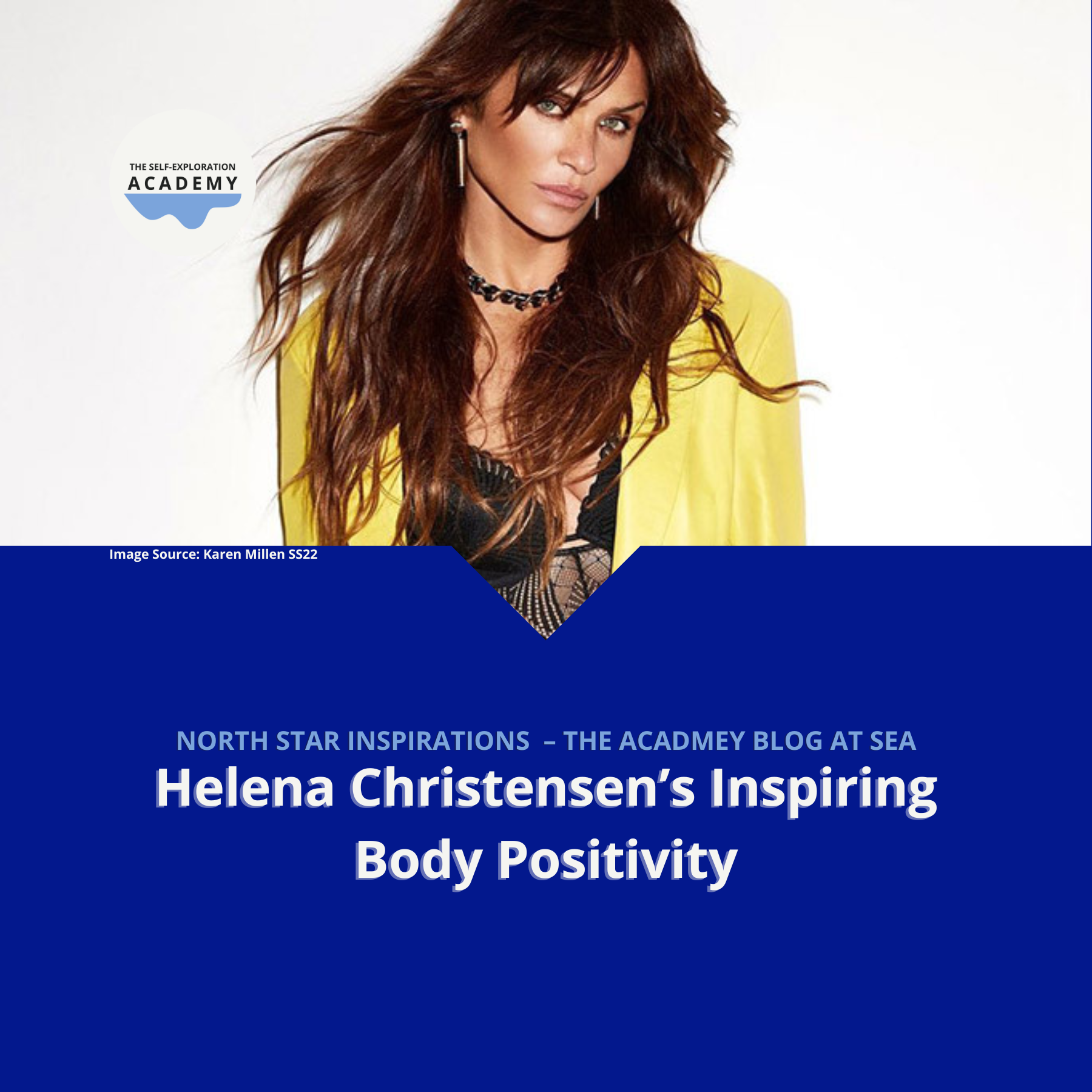
Danish model and photographer, and former Victoria's Secret model, Helena Christensen was in the news last week for her stunning looks and some inspiring statements she made about the female body.
The 53 year old supermodel, who became a globally famous breakout star for her leading role in the official music video for “Wicked Game” by Chris Isaak almost 30 years ago, made headlines last week for many things from her reunion with Eva Herzigova at the front row of Dolce & Gabbana's Autumn/Winter 2022 runway show for Milan Fashion Week (the show was curated by Kim Kardashian), to her jaw-dropping appearance as the face of the newest Coco de Mer Icons Collection campaign. And as amazing as each of these headlines are, nothing caught our attention like the ones we’re about to speak on.
A recent article published to Body+Soul illustrated the perspective of one journalist, Angela Mollard on fashion freedom and body positivity for middle aged women. Angela wrote her thoughts after reading the harsh criticisms of a former fashion publicist regarding Helena Chrstensen’s outfit choice for Gigi Hadid’s 24th birthday party.

“I refuse to be shamed into covering my arms,” Mollard says in the article. And fortunately, it seems the same is true for Helena, as we’ve seen in both her personal photos and professional work since that party in 2019.
Another statement that caught our attention in the press last week was one where Helena speaks on body confidence in a woman. In an article published to The Telegraph, Christensen is quoted saying “no woman feels confident about her body all the time – it’s just not possible.”
Reading this statement felt very freeing and inspiring for us, because we believe there is power in vulnerability and transparency, although it is not something we always display towards or receive from others.

This week, we are leaning into the power of getting real about how we feel about ourselves, and about the lives we lead. It’s not that we have to focus on being dissatisfied with ourselves or our lives – it’s about being freed from the dishonesty that societal pressures often trap us in when it comes to our image and who we really are.
Featured Courses
Related Posts
At 69 years old, Karen Bass started a new chapter in her life, and the life of the city of Los Angeles, as she assumes the role of the city’s 43rd chief executive. Not only has she made history as the first woman to become mayor in Los Angeles, she is also the second Black person to have ever been elected to this office. In our review of this remarkable feat, we took some time to reflect on a few universal core competencies that Mayor Bass has displayed throughout her career, and that are of high visibility and significance today.