

WELCOME TO
The Academic Blog
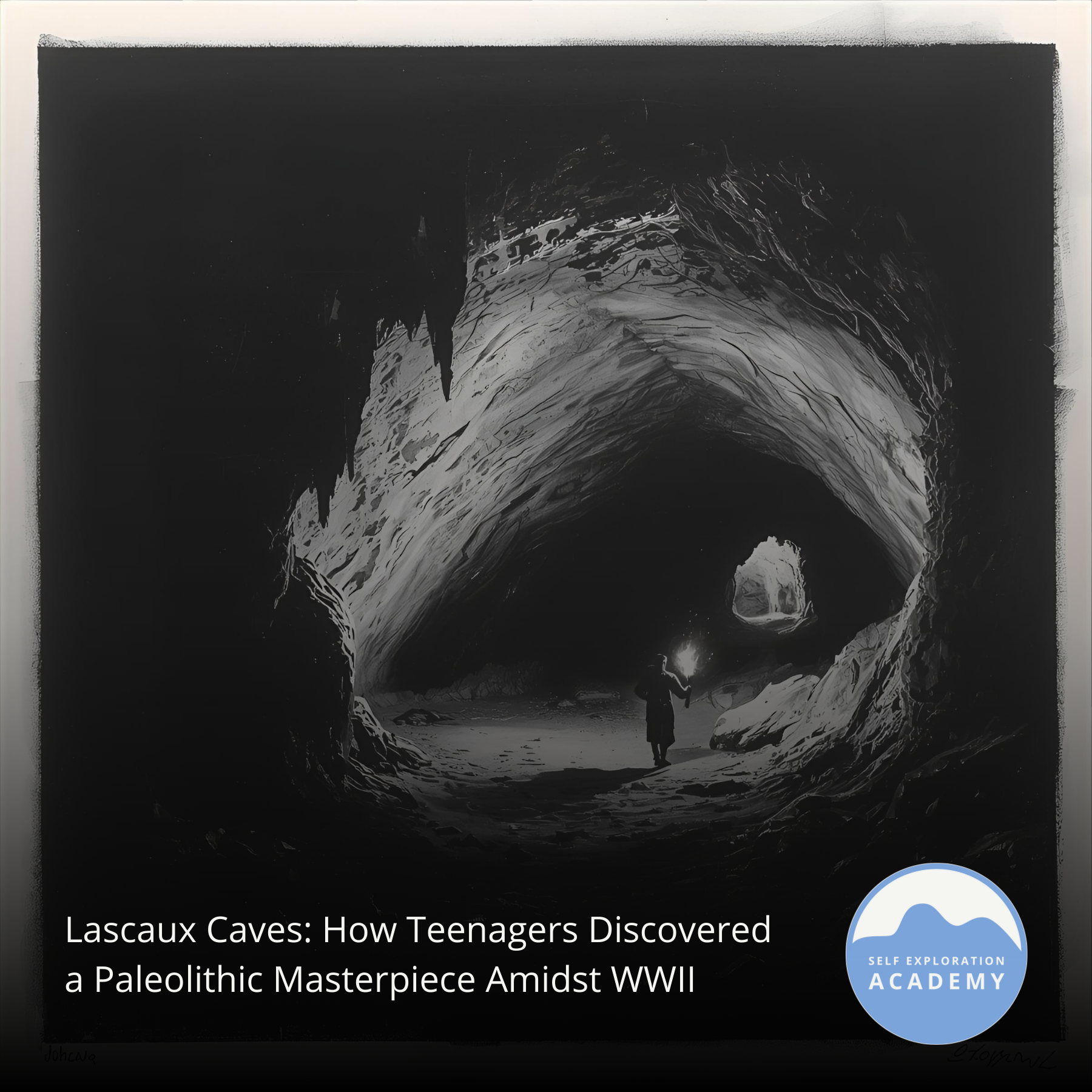
Lascaux Caves: How Teenagers Discovered a Paleolithic Masterpiece Amidst WWII
In 1940, four teenagers stumbled upon the ancient Lascaux Caves amidst WWII. Discover this incredible story of art, history, and responsible decision-making in a world at war.
A deep dive into the unexpected unveiling of humanity's ancient artistic heritage during one of its darkest hours.
The Moment Itself
On September 12, 1940, in the midst of World War II, a group of four French teenagers—Marcel Ravidat, Jacques Marsal, Georges Agniel, and Simon Coencas—along with Marcel’s dog, Robot, stumbled upon one of humanity’s most profound artistic treasures. The boys were exploring a rabbit hole near Montignac, in the Dordogne region of occupied France, when Robot disappeared into a narrow fissure. Marcel, curious, widened the opening and slid into the darkness, followed by his friends. What they found beneath the earth was not merely a cave, but a vast gallery of Paleolithic art, a breathtaking collection of paintings and engravings dating back approximately 17,000 years. The walls of Lascaux, as it would come to be known, depicted hundreds of animals—aurochs, horses, deer, bison, felines—rendered with astonishing skill and vitality, illuminated by the boys' flickering lamps. This discovery occurred under the shadow of Nazi occupation, a time when France was grappling with invasion and uncertainty. The world outside the cave was one of destruction and conflict, yet within this hidden chamber, an ancient testament to human creativity had remained untouched for millennia, waiting to be rediscovered. The stakes were immense: the preservation of an unparalleled archaeological and artistic record, and the understanding of early human culture.
The Emotional Landscape
For the four teenagers, the initial descent into Lascaux must have been a whirlwind of curiosity, trepidation, and then overwhelming awe. Imagine the sheer disbelief and wonder as their small lights danced across vibrant, ancient murals, revealing a world of prehistoric beasts frozen in time. This was not just a cave; it was a cathedral of human ingenuity from a forgotten era. Their immediate response was a mix of excitement and a deep, unspoken understanding of the magnitude of their find. They kept the secret for a few days, exploring further, before sharing their incredible discovery with their former schoolteacher, Léon Laval, who then alerted the renowned prehistorian Henri Breuil. For Breuil and other archaeologists, the emotional landscape would have been one of profound scientific validation, immense responsibility, and a sense of connection to their ancient ancestors. In a world consumed by the brutal realities of war, the unveiling of Lascaux offered a stark, poignant contrast—a reminder of enduring human artistry and the timeless pursuit of meaning, even as contemporary society spiraled into chaos. It was a moment of unexpected beauty and hope, a testament to the resilience of the human spirit amidst the darkest of times.
A Lesson in Social Emotional Learning
The discovery of Lascaux offers a compelling lesson in Responsible Decision-Making. Faced with an unprecedented find, the teenagers made the crucial choice to involve adults and experts rather than exploit or inadvertently damage the site. Their decision to alert their teacher, who in turn contacted archaeologists, demonstrates a profound sense of responsibility for a treasure that transcended personal ownership. In an era of global conflict, where destruction was rampant, their actions ensured the preservation of a fragile, irreplaceable piece of human heritage. This was not merely an act of reporting; it was a conscious, constructive choice that prioritized the collective good and the long-term scientific and cultural value of the caves. Their responsible decision-making allowed for the systematic study, documentation, and eventual protection of Lascaux, enabling generations to connect with the artistic expressions of our distant past. The moment speaks to us today as a powerful reminder that even in times of great upheaval, individual choices rooted in responsibility and foresight can safeguard invaluable legacies for all humanity.
Latest Posts










The Arc de Triomphe: A Monument Born of Conflict, Crowned by Compromise
Discover the complex story behind the Arc de Triomphe's 1836 inauguration. More than just an unveiling, it was a pivotal moment where a nation grappled with its imperial past and sought a unified future.
Explore the complex emotions and political maneuvers surrounding the 1836 unveiling of Paris's iconic monument.
The Moment Itself
On July 29, 1836, amidst the bustling avenues of Paris, a monumental structure finally stood complete and was officially inaugurated: the Arc de Triomphe. Conceived by Napoleon Bonaparte in 1806 after his stunning victory at Austerlitz, it was intended as a tribute to the invincible Grande Armée. Yet, the emperor who commissioned it never saw its completion, his empire crumbling long before the last stone was laid. Its construction spanned three distinct political regimes—the First Empire, the Bourbon Restoration, and finally, the July Monarchy under King Louis-Philippe. At stake was more than just a grand edifice; it was the symbolic reconciliation, or indeed, appropriation, of a nation's tumultuous past with its uncertain present. The inauguration represented a delicate political act, seeking to harness the potent legacy of Napoleonic glory for a new, more moderate France, without reigniting the imperial ambitions that had once plunged Europe into war.
The Emotional Landscape
The unveiling of the Arc de Triomphe would have evoked a profound and complex tapestry of emotions across French society. For the old guard, the veterans of Napoleon's campaigns, and fervent Bonapartists, it was a long-awaited vindication, a tangible reminder of past triumphs and a source of deep national pride. There would have been a palpable sense of awe at its sheer scale and solemnity in its purpose. Yet, for others—royalists, those weary of war, or families who bore the profound costs of the Napoleonic era—the monument might have stirred conflicting sentiments: lingering resentment, a painful memory of lives lost, or unease about the glorification of military power. The July Monarchy, itself a fragile compromise, sought to project an image of unity, but beneath the surface, the ideological fissures of revolution and empire still ran deep. The official celebration likely masked a complex interplay of genuine reverence, reluctant acceptance, and perhaps even quiet defiance, reflecting a nation still grappling with its identity.

A Lesson in Social Emotional Learning
The inauguration of the Arc de Triomphe offers a compelling lesson in Social Awareness. Louis-Philippe's decision to complete and inaugurate this distinctly Napoleonic monument, rather than abandon or diminish it, demonstrates a keen understanding of the collective psyche of the French people. Despite having overthrown the Bourbons and established a constitutional monarchy, his government recognized the profound and enduring reverence many French citizens held for Napoleon and the era of imperial glory. The Arc de Triomphe was not merely a building; it was a potent symbol embedded in the national consciousness, representing aspirations of power, destiny, and the memory of unparalleled military success. By completing it, Louis-Philippe’s regime sought to acknowledge and co-opt this powerful narrative, aiming to integrate it into the fabric of the new monarchy rather than creating further division by rejecting a significant portion of national memory. This act, whether successful in its unifying aim or merely a strategic political maneuver, highlights the critical importance of understanding diverse historical perspectives and collective emotions when navigating national identity and fostering cohesion.
The moment still speaks to us today, reminding us how historical monuments and symbols carry layers of meaning, often representing contradictions within a nation's story. It underscores the enduring challenge for societies to reconcile their past, however glorious or painful, with their present aspirations and future identity.
Latest Posts
Discover SEA’s 95 Universal Core Competencies—a research-informed, human-centered framework for building the life skills that actually matter. Organized in nine domains, this guide explores what it means to be truly capable.