
Lascaux Caves: How Teenagers Discovered a Paleolithic Masterpiece Amidst WWII
A deep dive into the unexpected unveiling of humanity's ancient artistic heritage during one of its darkest hours.
The Moment Itself
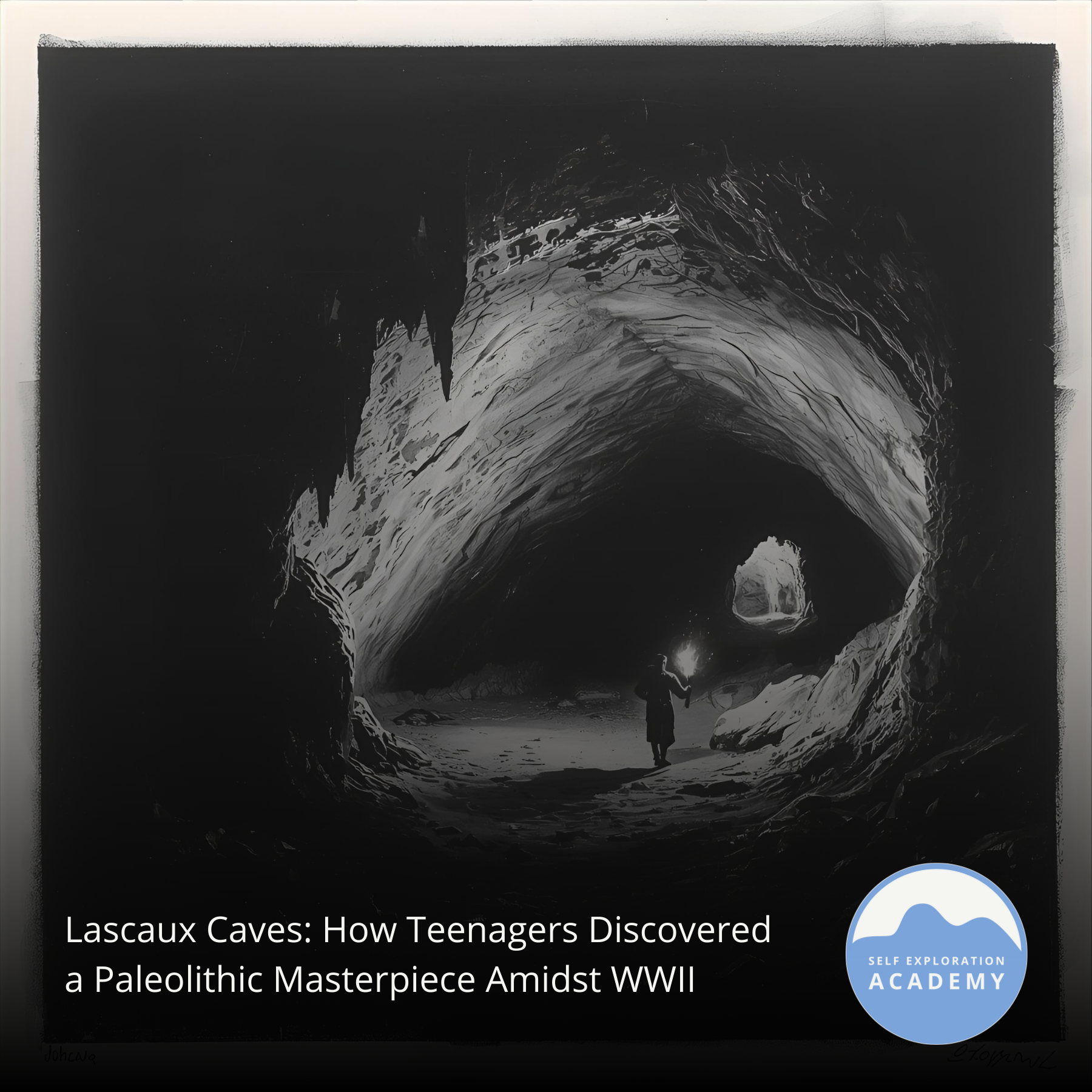
On September 12, 1940, in the midst of World War II, a group of four French teenagers—Marcel Ravidat, Jacques Marsal, Georges Agniel, and Simon Coencas—along with Marcel’s dog, Robot, stumbled upon one of humanity’s most profound artistic treasures. The boys were exploring a rabbit hole near Montignac, in the Dordogne region of occupied France, when Robot disappeared into a narrow fissure. Marcel, curious, widened the opening and slid into the darkness, followed by his friends. What they found beneath the earth was not merely a cave, but a vast gallery of Paleolithic art, a breathtaking collection of paintings and engravings dating back approximately 17,000 years. The walls of Lascaux, as it would come to be known, depicted hundreds of animals—aurochs, horses, deer, bison, felines—rendered with astonishing skill and vitality, illuminated by the boys' flickering lamps. This discovery occurred under the shadow of Nazi occupation, a time when France was grappling with invasion and uncertainty. The world outside the cave was one of destruction and conflict, yet within this hidden chamber, an ancient testament to human creativity had remained untouched for millennia, waiting to be rediscovered. The stakes were immense: the preservation of an unparalleled archaeological and artistic record, and the understanding of early human culture.
The Emotional Landscape
For the four teenagers, the initial descent into Lascaux must have been a whirlwind of curiosity, trepidation, and then overwhelming awe. Imagine the sheer disbelief and wonder as their small lights danced across vibrant, ancient murals, revealing a world of prehistoric beasts frozen in time. This was not just a cave; it was a cathedral of human ingenuity from a forgotten era. Their immediate response was a mix of excitement and a deep, unspoken understanding of the magnitude of their find. They kept the secret for a few days, exploring further, before sharing their incredible discovery with their former schoolteacher, Léon Laval, who then alerted the renowned prehistorian Henri Breuil. For Breuil and other archaeologists, the emotional landscape would have been one of profound scientific validation, immense responsibility, and a sense of connection to their ancient ancestors. In a world consumed by the brutal realities of war, the unveiling of Lascaux offered a stark, poignant contrast—a reminder of enduring human artistry and the timeless pursuit of meaning, even as contemporary society spiraled into chaos. It was a moment of unexpected beauty and hope, a testament to the resilience of the human spirit amidst the darkest of times.
A Lesson in Social Emotional Learning
The discovery of Lascaux offers a compelling lesson in Responsible Decision-Making. Faced with an unprecedented find, the teenagers made the crucial choice to involve adults and experts rather than exploit or inadvertently damage the site. Their decision to alert their teacher, who in turn contacted archaeologists, demonstrates a profound sense of responsibility for a treasure that transcended personal ownership. In an era of global conflict, where destruction was rampant, their actions ensured the preservation of a fragile, irreplaceable piece of human heritage. This was not merely an act of reporting; it was a conscious, constructive choice that prioritized the collective good and the long-term scientific and cultural value of the caves. Their responsible decision-making allowed for the systematic study, documentation, and eventual protection of Lascaux, enabling generations to connect with the artistic expressions of our distant past. The moment speaks to us today as a powerful reminder that even in times of great upheaval, individual choices rooted in responsibility and foresight can safeguard invaluable legacies for all humanity.
Latest Posts











Discover SEA’s 95 Universal Core Competencies—a research-informed, human-centered framework for building the life skills that actually matter. Organized in nine domains, this guide explores what it means to be truly capable.